BasicSignaling
The BasicSignaling class is used to work with methods that calculate the value of an output signal based on a single input signal.
To import this class use:
import ru.biosoft.physicell.core.BasicSignaling
All members of the BasicSignaling class are presented below.
Class member |
Description |
|---|---|
static double linear_response_function(double signal, double min, double max) |
signal - the value of the incoming signal.
min - minimum value.
max - maximum value.
returns the response to signal using the following formula:
\(\frac{signal-min}{max-min}\),
displaying the signal value from the segment [min, max] to the segment [0, 1].
Example of usage.
|
static double decreasing_linear_response_function(double signal, double min, double max) |
signal - the value of the incoming signal.
min - minimum value.
max - maximum value.
Returns the response to signal using the following formula:
\((signal-max)*(max-min)\),
displaying the signal value from the segment [min, max] to the segment [-1, 0].
Example of usage.
|
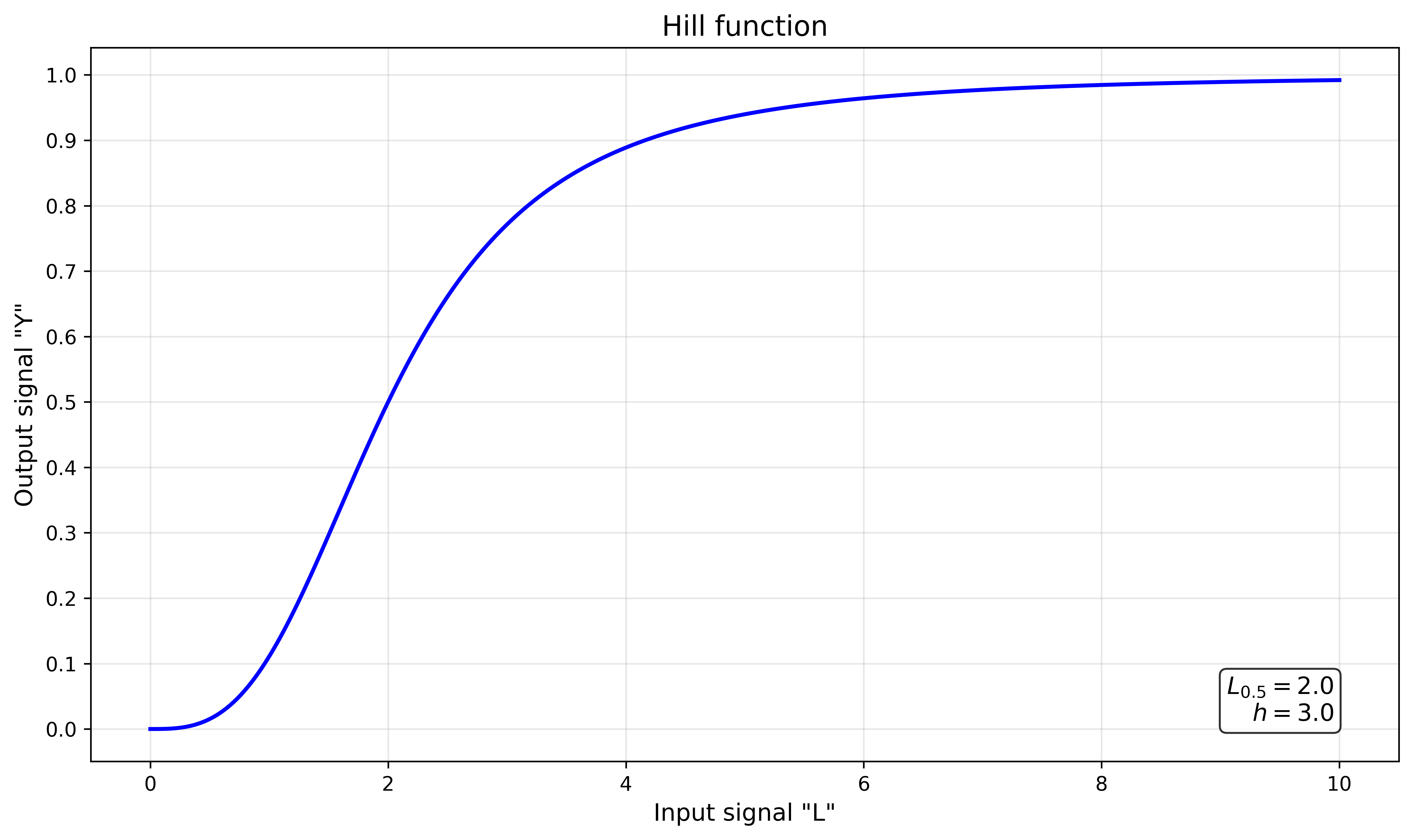
static double Hill_response_function(double signal, double half_max, double hill_power) |
signal - the value of the incoming signal.
half_max - signal value at which the response reaches half of its maximum possible value.
hill_power - Hill coefficient.
Returns the response to signal using the Hill formula.
Example of usage.
|
Hill’s formula
Hill’s formula is as follows:
Where:
Y - значение выходящего сигнала.
L - значение входящего сигнала.
\(L_{0,5}\) - значение входящего сигнала, при котором значение выходящего сигнала равно половине от максимального возможного.
h - Hill coefficient.
The graph of this function is S-shaped.