Life Cycle
After clicking on the Cycle tab in the properties panel on the right, you will have a menu where you can change the parameters of the cell’s life cycle.
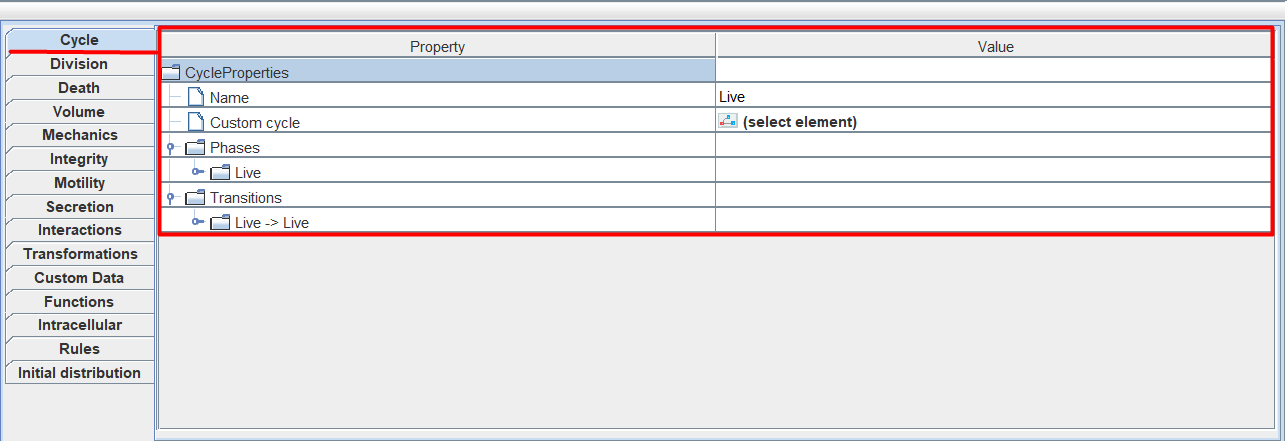
Name of the cell life cycle (Name)
When clicking to the right of the  Name opens a list in which you can select the type of cell life cycle:
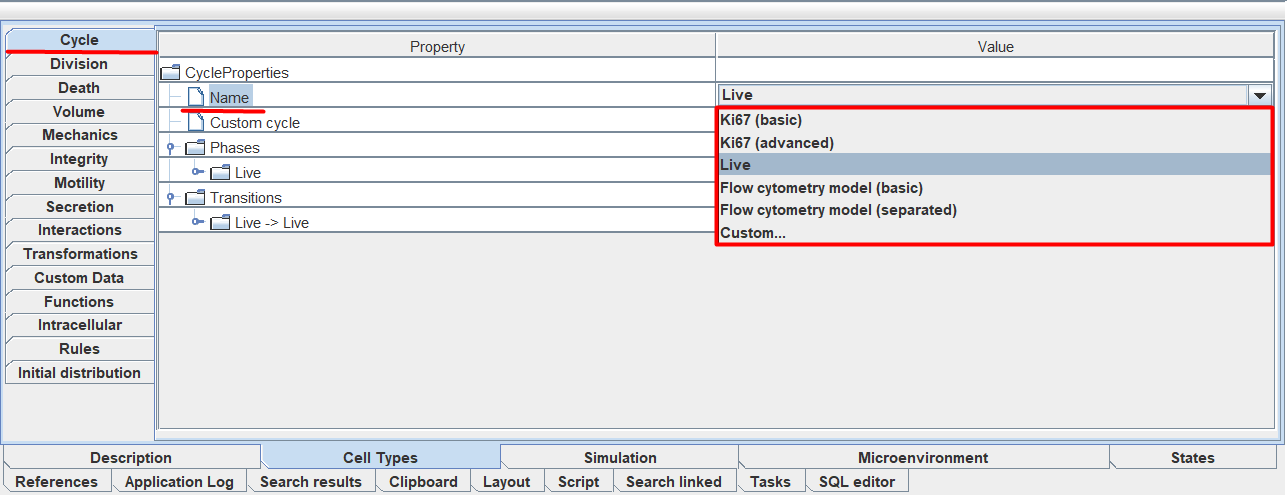
Ki67 (basic): life cycle consisting of two phases - "Ki67-" and "Ki67+",
Ki67 (advanced): life cycle consisting of three phases - "Ki67-", "Ki67+ (premitotic)", and "Ki67+ (postmitotic)",
Live: the simplest life cycle, consisting of just one phase with the code name "Live",
Flow cytometry model (basic): life cycle consisting of three phases - “G0/G1”, “S”, and “G2/M”,
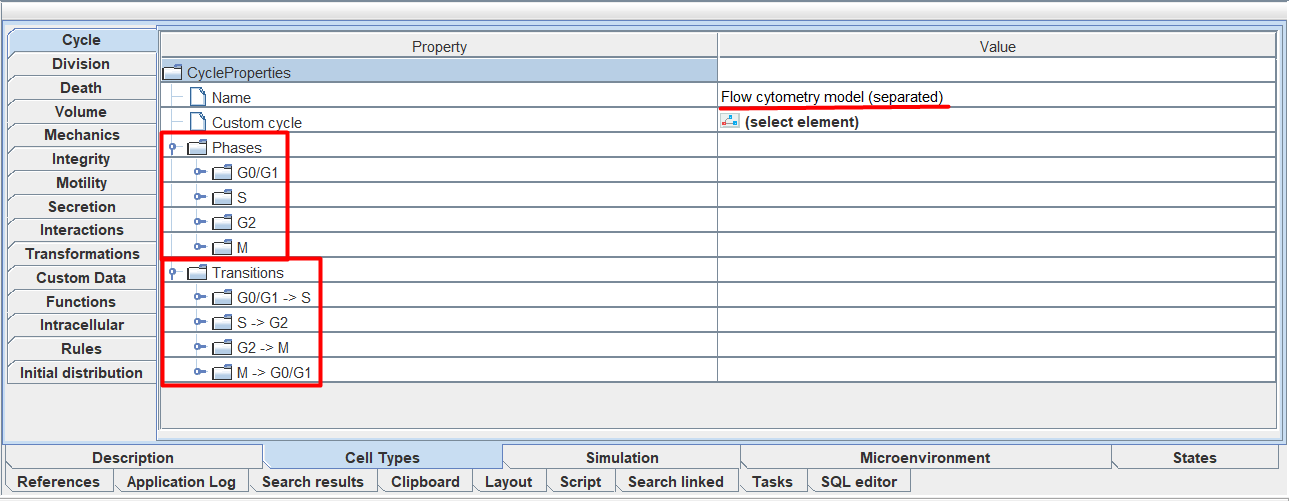
Flow cytometry model (separated): life cycle consisting of four phases - “G0/G1”, “S”, “G2”, and “M”,
Custom: custom lifecycle.
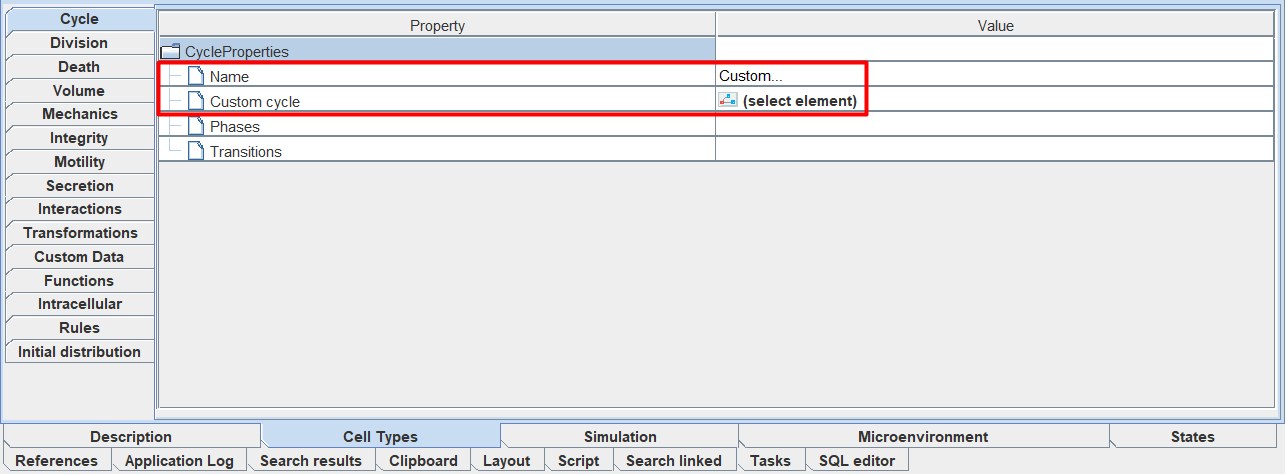
When you select Custom… to the right of the Custom cycle you will need to specify the path to the model that describes the life cycle of the cell.
Phases of the cycle (Phases) and transitions between them (Transitions)
When you select a specific cycle, the Phases (cycle phases) and Transitions (transitions between cycle phases) field tabs automatically change.
To open any tab of the Phases or Transitions fields, you need to click LMB on the  to the left of the tab. To close a tab, click LMB on the icon
  to the left of the tab.
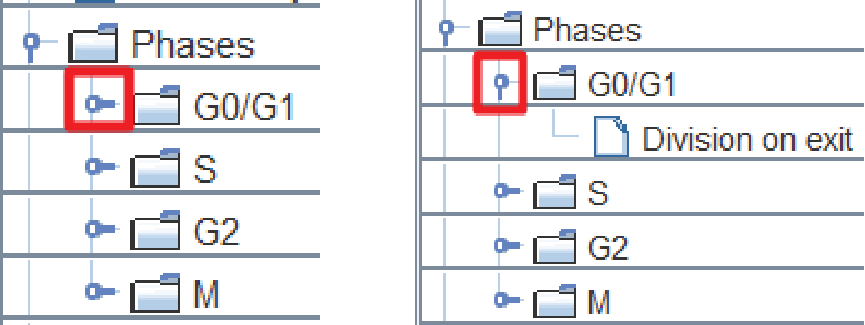
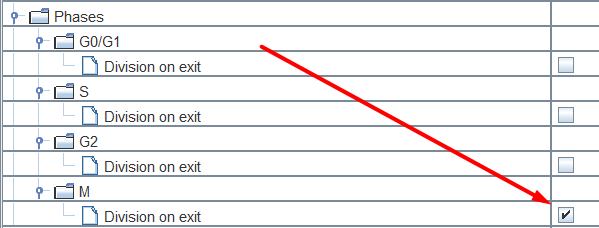
When you open any of the tabs in the Phases field, the icon Division on exit appears. Check ☑ if you want the cell to divide at the end of the selected phase of the life cycle.
When you open any of the tabs in the Transitions field, two icons will appear:
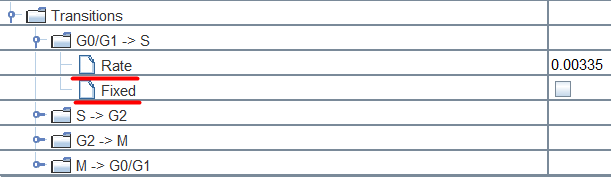
- Rate: the rate of transition between the corresponding phases of the cell’s life cycle (can be changed by clicking LMB on the number on the right and entering your own value),
- Fixed: Check ☑ if you want the transition time between the corresponding phases of the cell’s life cycle to be fixed.
Note
When the Fixed property is specified, the transition between phases of the cell’s life cycle occurs exactly \(1/Rate\) time units after the start of the phase.
If Fixed is not specified, then the transition occurs on average \(1/Rate\) time units after the start of the phase. This is modeled as follows: during each step of the agent (cell), a transition can occur with the probability \(Rate*Phenotype \, dt\), where Phenotype dt is the model time step with which the internal state of the cells is updated (set in the model simulation settings).
Editing phases and transitions between them
To add a new phase or transition to a cell’s life cycle, you need to:
Click LMB on the tab
Phases or Transitions.Click LMB on the
 icon.
icon.
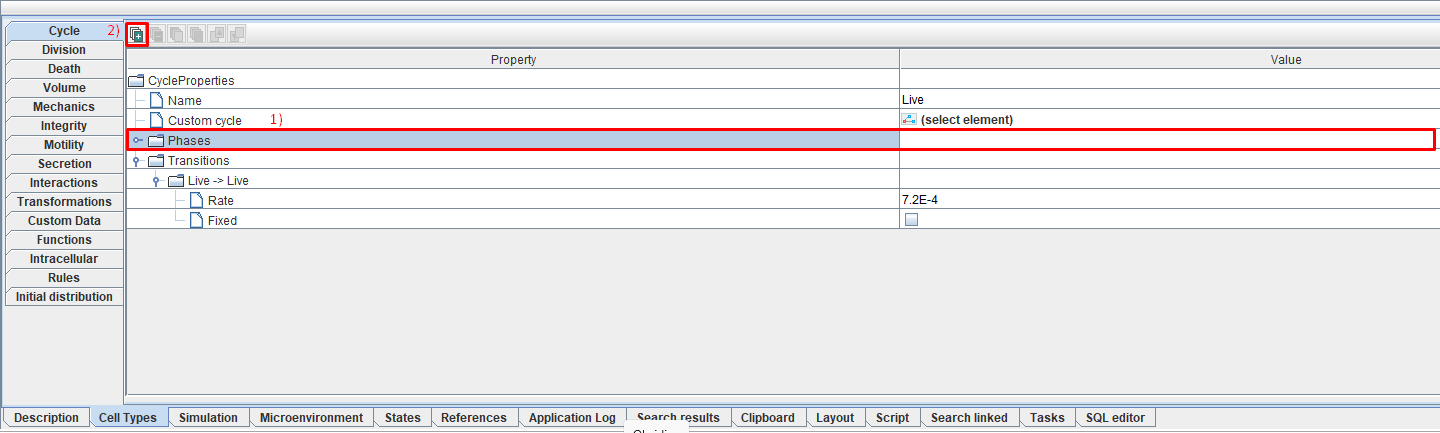
After this, a new phase or transition will appear in the corresponding section.
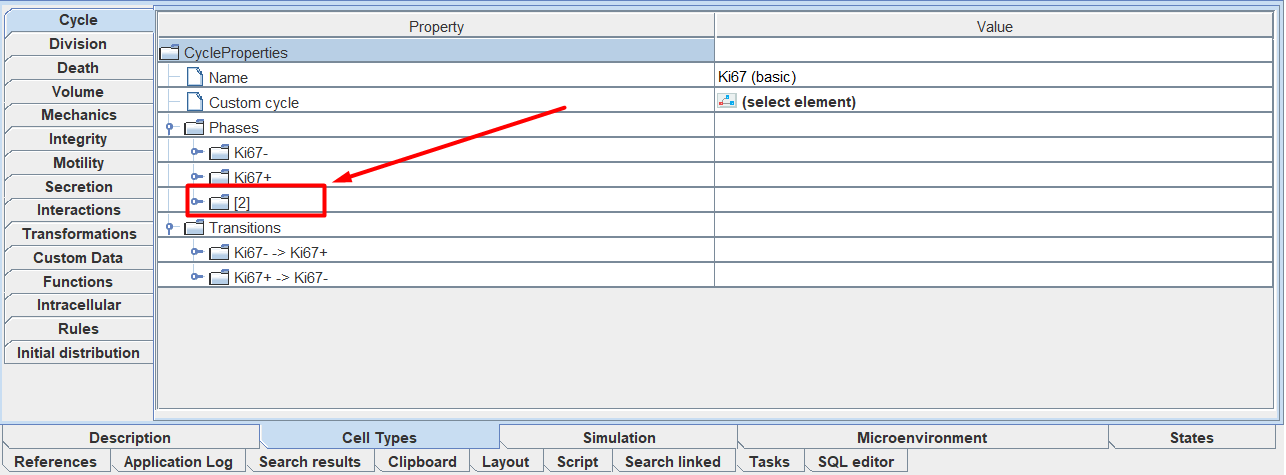
In addition, other actions with phases and transitions are possible. To display them, you need to click LMB on any phase or transition, after which a panel with possible actions will appear at the top.
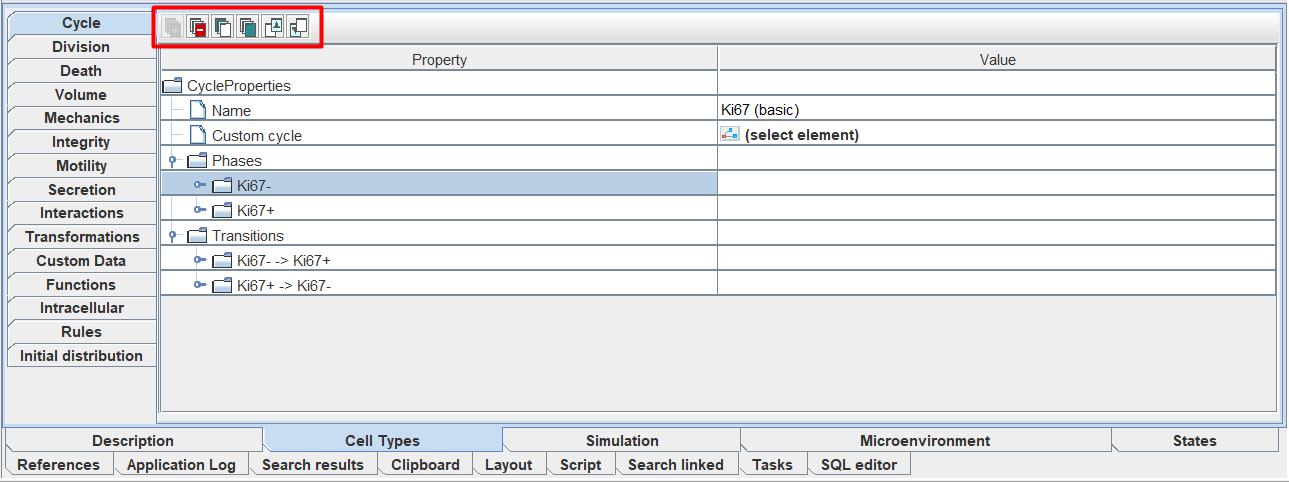
A description of each of these actions is given below.
Designation |
Description |
|---|---|

|
Deleting a selected phase or transition |

|
Insert a new phase or transition before the selected one |

|
Insert a new phase or transition after the selected one |

|
Move selected phase or transition higher |

|
Move selected phase or transition below |